
The recently released Easter crash figures which showed that Easter road deaths increased to 235 (from 187 in 2016), coupled with the Bronkhorstspruit crash which occurred on 21 April 2017 on the R25 on the border between Mpumalanga and Gauteng provinces highlight the huge task that we face as we try to curb the road carnage on our roads. The Bronkhorstspruit crash is particularly horrendous considering that 18 of the 20 fatalities in that crash were schoolchildren on their way home from school. Ironically, the Bronkhorstspruit crash (which claimed the lives of children from Refano Primary School and Mahlenga Secondary School) occurred on the same day that the Easter crash statistics were released. While not suggesting that speed was the cause for the Bronkhorstspruit crash, it is noteworthy that speeding (together with overloading) were the main offences committed by motorists over the Easter weekend with a total of 1 730 motorists being caught and fined for speeding across the country.
The upcoming 4th United Nations Global Road Safety Week that will be observed from 8-14 May 2017[1] is therefore particularly timely for South Africa as it will focus on speed and what can be done to address this key risk factor for road traffic deaths and injuries. The week will run under the theme Save Lives #SlowDown. With 14 000 lives lost and a ZAR306 billion cost per year, the human and economic toll of road traffic crashes should be compelling reasons for us to slow down not only during the Week but thereafter as well.
Why focus on speed?
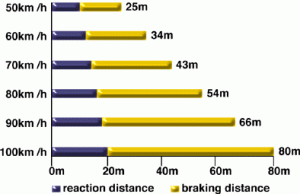
There are two components to vehicular speed and these are equally important. The first one is speeding which refers to driving above the speed limit, a common occurrence in South Africa. The second is inappropriate speed which refers to driving too fast for the conditions, for example driving at the speed limit in rainy weather). Both excessive and inappropriate speed are recognised as important factors contributing to road crash fatalities and severe injuries (WHO, 2013)[2]. This is because, firstly; the chances of a crash increase with speed due, for instance to the longer stopping distances at higher speed (see first graph below) and secondly due to the fact that the crash severity increases with vehicle speed. This is particularly illustrated by probability of death for pedestrians involved in a collision with a vehicle travelling at different speeds as shown below:
 |
 |
| Total stopping distance=reaction distance plus braking distance. Stopping distance lengthens with increasing speed | A pedestrian knocked down by a vehicle travelling at 70km/hr or more has minimal chances of survival |
Factors influencing speeding
There is therefore a case to be made for speed reductions and compliance with speed limits. Improving compliance with speed limits and reducing unsafe speeds are however not easy tasks with drivers speeding for a variety of reasons e.g.[3].
- travelling at higher speeds offers the immediate reward (as a perception, if not in practice) of a shorter journey time
- lack of adverse consequences every time one travels above the speed limit
- perception that one cannot be involved in a serious crash
- circumstances of individual trip e.g. speeding because one is driving a company-owned car and not a personal one
- most drivers consider themselves above average in terms of skill
- pressure from employers to meet targets might force commercial drivers to speed
Resistance to speed reduction is an enormous challenge partly because of the opposing factors that need to be overcome. For instance:
- public transport operators and freight industry may feel it impacts on revenue
- perception that speed enforcement is only for fine revenue
- perception of shorter journey times and
- perception that speed does not kill. A common counter-argument whenever one argues for speed reduction is the low crash rate on autobahns in Germany. This last argument however conveniently fails to mention that not all roads in Germany are autobahns and that speed on local roads in Germany are actually very low.
The difficulty in introducing mandatory speed reductions is perhaps best exemplified by the fact that speed reductions in South Africa were proposed as one of five legislative changes in draft regulations that were published in the Government Gazette in 2015. With regard to speed reductions, the proposed changes were for speed limits to be reduced as follows:
- from 60km/hr to 40km/hr in urban areas,
- from 100km/hr to 80km/hr in rural areas, and
- from 120km/hr to 100km/hr on freeways running through a residential area
Sadly, the reaction to this was largely negative if not outright resistance and up to now there seems not to have been much progress regarding the approval and adoption of this proposal. Considering this lack of progress in adopting mandatory speed reductions, in my opinion we are therefore still in search of strategies to address speed.
Among the proven strategies to address speed include[4]:
- Building or modifying roads to include features that calm traffic
- Establishing speed limits to the function of each road
- Enforcing speed limits
- Installing in-vehicle technologies
- Raising awareness about the dangers of speeding.
With regard to the last bullet above, a short-term measure that communities and other stakeholders can implement is SloWDown Days as part of the 4th Global Road Safety Week (see toolkit on http://www.who.int/violence_injury_prevention/publications/road_traffic/SlowDown_Days/en/
Another way we can raise awareness is by taking the pledge at https://www.unroadsafetyweek.org/en/home
Lastly, do not forget to register your event at http://who.int/roadsafety/week/2017/event-registration/en/
While the SlowDown campaign is useful in raising awareness, in the long run, we need to advocate for speed reductions and speed up the implementation of traffic calming measures. Hopefully, the activities during the 4th Global Road Safety Week will create enough awareness and and concietise enough people about the rationale and need for speed reductions in South Africa. The benefits of speed reduction in my opinion far outweigh any arguments for maintaining our current speed regime, particularly in residential areas.
Traffic calming is key
With the caveat that there is no silver bullet in curbing the scourge of road traffic crashes, in my opinion; traffic calming in our neighbourhoods is THE most effective strategy that we can use to improve our appalling road safety record and can go a long way in protecting our most vulnerable road users: children. Regardless of how well they are taught in road safety, children’s pedestrian skills remain limited and they therefore need to be protected. We can acknowledge the reality of children’s limited pedestrian skills by retrofitting our roads to make them more forgiving of children’s ‘mistakes’ on the road. Regardless of how good enforcement is, traffic officers cannot be on every street all the time.
We therefore need measures that force drivers to slow down. From my experience, we tend to treat road signs and lights as suggestions. Traffic calming tools like speed humps, road narrowing etc. however cannot be ignored by drivers. In a manner of speaking, they force drivers to drive slowly and carefully (even in the absence of traffic police and speed cameras) thereby protecting the many children who share our streets with motorists. The speeding up of the implementation of traffic calming measures in neighbourhoods in South Africa and elsewhere should, in my opinion; be the goal of all the activities that we are going to implement during this year’s road safety week. I would personally consider it a huge success if even a single speed hump is constructed as a direct result of the various awareness campaigns that we will be partaking in during the week from 8-14 May 2017.
Notes
[1] Previous Global Road Safety Weeks have been held in the past as follows:
- 1st UN GRSW April 2007,
- 2nd UN GRSW (April 2013) focusing on pedestrian safety under the theme Make Walking Safe
- 3rd UN GRSW (May 2015) focusing on child road safety under the theme #SaveKidsLives
[2] See WHO, 2013 Speed Management Manual. Available at http://apps.who.int/iris/bitstream/10665/43915/1/9782940395040_eng.pdf
[3] Adapted from WHO, 2013 Speed Management Manual. Available at http://apps.who.int/iris/bitstream/10665/43915/1/9782940395040_eng.pdf
[4] See 4th UN Global Road Safety Week website https://www.unroadsafetyweek.org/en/home
