
Available data points towards the vulnerability of pedestrians to road crashes and that a significantly higher number of pedestrian injuries and fatalities occur over the winter months. This suggests that light and weather conditions may be factors increasing crash risk for pedestrians. With the winter season setting in, I therefore encourage that schoolchildren (particularly those who walk to school) be provided with reflective apparel that enhances their visibility to motorists. Such apparel includes (but is not limited to) reflective vests, backpacks and tracksuits with reflective strips on the ankles, knees and elbows). The latter are highly recommended because of their configuration. This is because they harness the concept known as biological motion (or ‘biomotion’)-that is, ‘our visual sensitivity to patterns of human motion’. Apparel like tracksuits and jackets with reflective strips on the knees move with the movement of a pedestrian and therefore are more easily identified as being the shape and movement of a human being.
Rationale for high-visibility aids
Firstly, most school uniforms are dark in colour. This unfortunately means children are not visible to motorists. Even for those schools that have bright-coloured uniforms; often, the jersey for those uniforms are dark coloured. This makes it imperative to provide children with high-visibility aids that enhances their visibility.
Secondly, school starts early; around 08h00 or even earlier for those who attend early morning classes or extra-curricular activities before school starts and it is still dark when they leave home (also dark by the time some of them return home e.g. those who take part in extra curricula activities). The darkness at these times make it imperative to provide children with high-visibility aids
Lastly, many organisations already provide reflective gear for their workers particularly those who work outdoors. Think of the construction workers, street cleaners etc. Surely, if organisations are concerned about the safety of their employees and strive to make them more visible, the same concern should be extended to our children who are the most vulnerable members of our society.
What are the options?
As indicated earlier there are various options, including:
- High-visibility bibs/vests/jackets
- High-visibility sashes (that can be put across the chest and stomach or tied) onto bags or on their shoes
- Snap-on slap bands (that are slapped around the wrist or ankle)
- Backpacks with reflective strips sewn or tied to the backpack
- Tracksuits
- sewing a strip of reflective tape on children’s bags or dark coloured uniform
- Raincoats
- Bright coloured clothes. They can wear these on top of their school uniform and take these off when they get to school
Examples of high-visibility aids used in selected road safety projects in Cape Town
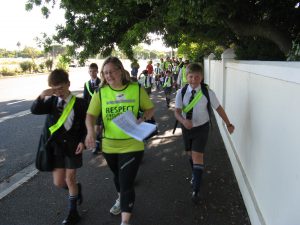 Reflective vests (adult volunteer) and sashes children-Rondebosch Boys Prep School (University of Cape Town walking bus pilot project-2011) Reflective vests (adult volunteer) and sashes children-Rondebosch Boys Prep School (University of Cape Town walking bus pilot project-2011) |
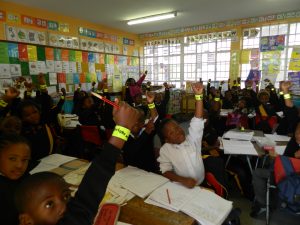 Reflective snap-on slap bands-Chumisa Primary School (GRSP ZA/Childsafe South Africa/Western Cape Government-3rd Global Road Safety Week-2015) Reflective snap-on slap bands-Chumisa Primary School (GRSP ZA/Childsafe South Africa/Western Cape Government-3rd Global Road Safety Week-2015) |
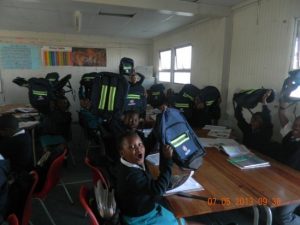 Backpacks with reflective strip-DuNoon primary school GRSP ZA/Chevron/Western Cape Government Learner visibility Project-2013) Backpacks with reflective strip-DuNoon primary school GRSP ZA/Chevron/Western Cape Government Learner visibility Project-2013) |
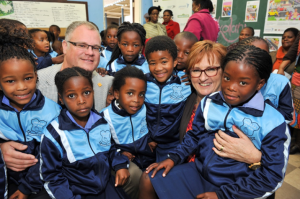 Reflective tracksuit tops-Imbasa Primary school (Childsafe South Africa Safe Travel to School project-2015 Reflective tracksuit tops-Imbasa Primary school (Childsafe South Africa Safe Travel to School project-2015 |
Which option one chooses is a matter of personal choice. However, in my experience, the retention rate of visibility aids such as bibs, wrist bands and sashes is very low. I would therefore recommend strips sewn onto children’s uniforms, tracksuits or bags. It is important to point out that most of these options are relatively inexpensive, for instance, a basic safety bib costs no more than ZAR30 and can be found in most hardware shops or shops that sell automotive parts. Thus, cost should be the least of your worries in making your child more visible to motorists. This is an insignificant investment compared to the cost of your child being knocked by a car because the child was not visible to motorists.
What are the possible challenges?
A big challenge is likely to be retention of the high-visibility gear. Over the years, I have personally been involved in programmes that distributed high-visibility vests to children at the beginning of a week and upon checks at the end of the week to see the retention of the vests found that most children no longer had the vests. The two main reasons proffered for not putting the vests included that the vests had either been lost or were taken by an adult in the child’s household. On the basis of this low retention rate, sewing reflective strips on the child’s uniform or bag might be the way to go.
You are also likely to encounter resistance particularly from older children who may feel less inclined to be conspicuous in their high-visibility gear. However, this resistance may most likely be a result of a lack of appreciation of the rationale for the high-visibility aids. It is therefore important to explain the safety imperative of being visible to children before asking them to put on the high-visibility aids. It is important to instill in children a sense that; as they say in their parlance, it is ‘cool’ to wear reflective gear.
Another way to circumvent resistance is to be creative in the choice of gear. Being visible does not only come with wearing a vest/jacket. Discuss with your child and get them gear that is part of their everyday apparel. In this regard, simply adding reflective strips to their tracksuits or on their bag could help. You may however need to speak to your school and agree on the need to add reflective strips to the children’s uniforms.
In conclusion, in case you are planning to purchase that expensive winter jacket for your child that you have been contemplating for a while, you may want to go for a lighter colour so that you kill two birds with one stone so to speak; warming up your child while simultaneously ensuring that that s/he is more visible to motorists.
Please brighten them all up this winter and save children’s lives.
